By Visiblo • 13 May 2026 • 11 min read
Entity SEO for AI Search: How AI Understands Brands and Context
Introduction to Entity SEO in AI Search
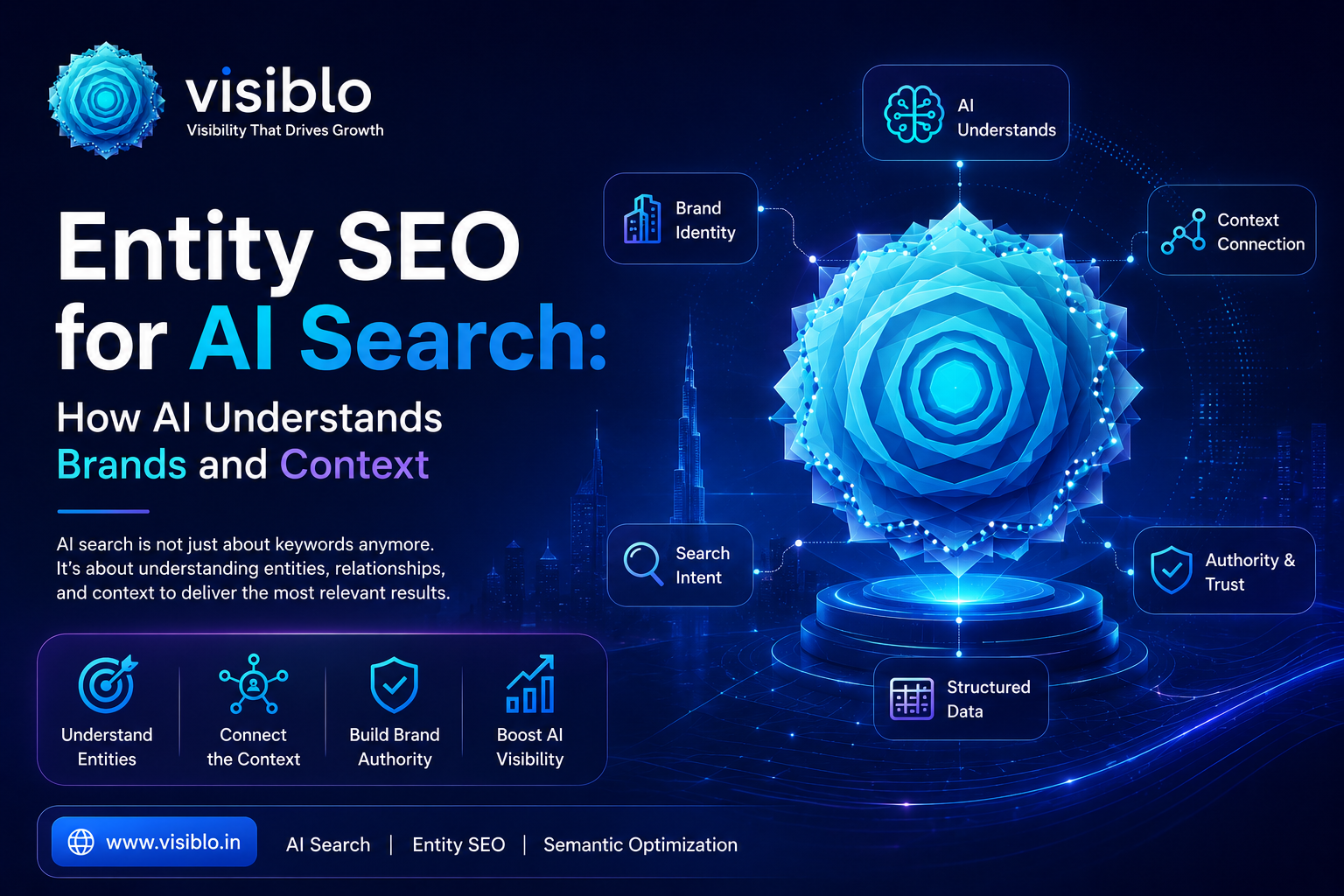
Entity SEO for AI Search: How AI Understands Brands and Context

The future of search is being reshaped by Artificial Intelligence . Gone are the days when search engines relied solely on keywords. Today, AI-driven search systems understand entities, relationships, intent, and contextual meaning to deliver more intelligent and accurate results. This shift has made Entity SEO a vital strategy for businesses seeking visibility in AI search platforms like Google AI Overviews, Perplexity, and voice assistants. If your brand wants to rank in the future of search, you need to optimize not only for keywords but also for how AI views your business, products, services, and expertise. Today’s search engines aren’t just looking for keywords. Today’s AI-powered search systems understand entities, relationships, intent and contextual meaning to provide smarter, more accurate results.
This shift has placed Entity SEO at the forefront of strategies businesses need to implement to stay visible on AI-powered search platforms such as Google AI Overviews, ChatGPT, Gemini, Perplexity, and voice assistants.
If your brand wants to rank in the future of search, you’ll need to optimize not just for keywords, but for how AI understands your business, your products, your services and your expertise.
What is Entity SEO?
Entity SEO is the process of optimising your website and digital presence for search engines to better understand: Who you are What your business does Your relevance in your industry Your expertise, Your relationship to other topics and brands. In simple terms, an entity is a uniquely identifiable thing. It can be: A business, A person, A product ,A location An organization,A service, A concept
For example:
Apple = Technology company, Dubai = City, Elon Musk = Person, SEO = Digital marketing concept,
AI search systems link these entities together to understand meaning beyond keywords.
Who are you be.
What your business does
Relevance to your industry
Your ability
Your relationships with other topics and brands
In simple terms, an entity is a thing that can be uniquely identified. Maybe it’s:
A business
One person
A product
Somewhere
Organization
A service
One idea
For instance:
Apple = Tech company
Dubai is a city.
People = Elon Musk
SEO = Digital marketing idea
AI search systems link these entities to each other to understand the meaning beyond keywords.
Why Entity SEO Matters in AI Search
Traditional SEO focused heavily on keywords. But AI search engines now use:
Natural Language Processing (NLP)
Knowledge Graphs
Semantic Search
Machine Learning
Contextual Understanding
This means AI can understand:
Brand authority
Topic relevance
User intent
Industry relationships
Contextual meaning
If your website only stuffs keywords without building topical authority and contextual signals, it may struggle to rank in AI-driven search results.
How AI Understands Brands and Context
AI search systems analyze multiple signals to understand a brand. These include:
1. Website Content Consistency
AI checks if your website has consistent coverage of relevant topics.
For example, if you sell SEO services, your content would automatically include:
Technical SEO
Local SEO AI SEO
Semantic Search Engine Optimization
Marketing Content
entities optimization
Topical consistency tells AI what you are an expert in.
2. Brand Mentions Across the Web
AI search engines look beyond your website.
They analyze:
Social media mentions
Business directories
News articles
Guest posts
Reviews
Citations
The more your brand appears in trusted sources, the stronger your entity becomes.
3. Structured Data and Schema Markup
Schema markup helps search engines clearly identify your business information.
Important schema types include:
Organization Schema
Local Business Schema
Article Schema
FAQ Schema
Product Schema
Person Schema
Structured data improves semantic understanding and helps AI connect your brand with relevant topics.

Semantic SEO vs Traditional SEO
Semantic SEO creates content clusters that help AI understand your website deeply.
Key Strategies for Entity SEO Optimization
1. Build Topical Authority
Create comprehensive content around your niche.
Example for a digital marketing agency:
Technical SEO
Local SEO
GEO Optimization
Content Strategy
Semantic Search
Voice Search SEO
Publishing related content helps AI connect your expertise with the industry.
2. Use Natural Language and Context
AI understands conversational content better than robotic keyword stuffing.
Instead of:
“Best SEO company SEO services best SEO agency”
Write:
“Professional SEO services help businesses improve search visibility, brand authority, and organic traffic growth.”
Natural context improves AI comprehension.
3. Optimize for Google Knowledge Graph
Google’s Knowledge Graph connects entities and relationships.
To improve visibility:
Maintain consistent business information
Create author profiles
Build high-quality backlinks
Get featured in trusted websites
Use structured data
4. Strengthen Brand Signals
AI trusts recognizable brands.
Ways to improve brand authority:
Publish expert content
Gain online mentions
Encourage customer reviews
Maintain active social profiles
Build PR campaigns
Use branded anchor text
The stronger your brand identity, the easier AI can recognize and recommend your business.
5. Create Contextual Internal Linking
Internal linking helps AI understand content relationships.
Example:
A blog about “AI SEO” should internally link to:
Technical SEO
Entity SEO
Semantic SEO
Content Optimization
Search Engine Algorithms
This creates a semantic content network.
GEO Optimization for AI Search
GEO optimization (Generative Engine Optimization) is becoming essential for visibility in AI-generated search results.
AI engines like ChatGPT and Google AI Overviews prioritize:
Trusted sources
Expert-written content
Clear structure
Contextual depth
Brand authority
Accurate information
GEO Optimization Best Practices
Use clear headings
Write concise paragraphs
Add FAQs
Use schema markup
Include expert insights
Build topical clusters
Optimize for conversational queries
How Visiblo Helps Businesses with AI SEO
Visiblo helps businesses adapt to the future of search with advanced:
Entity SEO strategies
Semantic SEO optimization
GEO optimization
AI-focused content marketing
Brand authority building
Technical SEO solutions
By combining AI search optimization with modern SEO techniques, businesses can improve visibility across Google, AI search engines, and voice search platforms.
Common Entity SEO Mistakes to Avoid
Ignoring Brand Consistency
Different business names, phone numbers, or descriptions confuse AI systems.
Keyword Stuffing
AI prioritizes natural context over repetitive keywords.
Weak Content Structure
Poor headings and unclear organization reduce semantic understanding.
No Schema Markup
Without structured data, AI struggles to identify your entities properly.
Thin Content
Short, low-value content weakens topical authority.
Future of AI Search and Entity-Based SEO
The future of SEO is shifting from keywords to contextual intelligence.
Search engines are evolving toward:
AI-generated answers
Conversational search
Predictive intent
Knowledge-based ranking
Contextual understanding
Businesses that invest in Entity SEO today will gain a major competitive advantage in future search ecosystems.
Final Thoughts
Entity SEO is no longer optional. As AI-powered search continues to evolve, businesses must optimize for meaning, relationships, authority, and contextual relevance.
Instead of focusing only on keywords, focus on:
Building topical expertise
Strengthening brand signals
Using semantic structure
Improving contextual relevance
Creating high-quality user-focused content
With the right Entity SEO strategy, your business can improve visibility across Google Search, AI Overviews, ChatGPT recommendations, and future AI-driven search platforms.
FAQs
What is Entity SEO?
Entity SEO is an SEO strategy focused on helping search engines understand brands, topics, people, and relationships using semantic context rather than only keywords.
Why is Entity SEO important for AI search?
AI search engines rely on contextual understanding and semantic relationships. Entity SEO helps AI recognize your expertise, authority, and relevance.
What is GEO optimization?
GEO optimization stands for Generative Engine Optimization. It helps content appear in AI-generated search results and conversational AI platforms.
How does AI understand brand authority?
AI analyzes brand mentions, backlinks, topical relevance, structured data, reviews, and content consistency across the internet.
Is semantic SEO the future?
Yes. Semantic SEO and Entity SEO are becoming essential because AI search engines prioritize context and meaning over exact keyword matching.