By Visiblo • 27 May 2026 • 26 min read
From Keywords to Entities: The Evolution of SEO in AI Search
Introduction to AI-Powered SEO
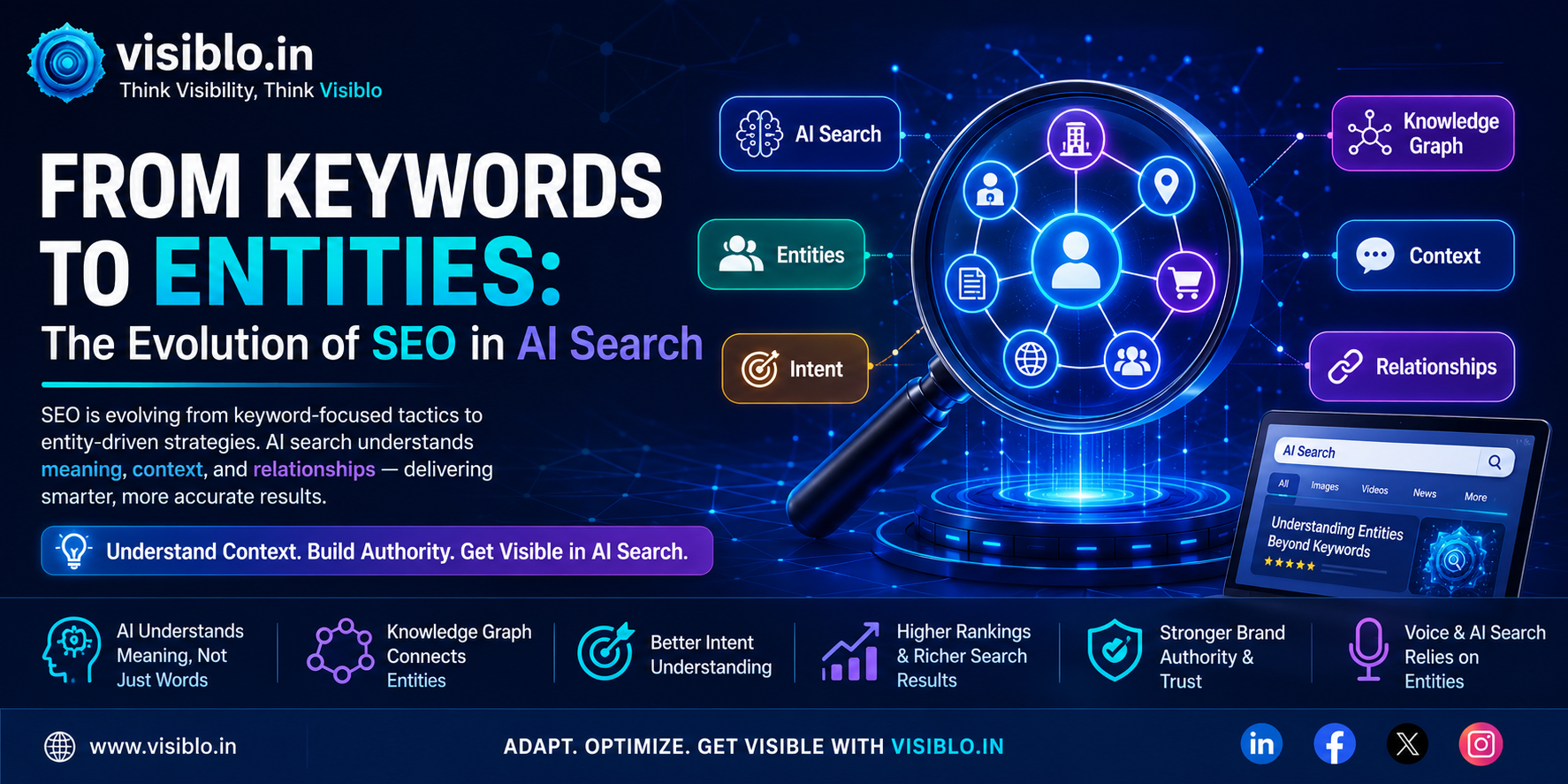
From Keywords to Entities: The Evolution of SEO in AI Search
The world of SEO is changing faster than it ever has. If you want to rule search rankings, old-school keyword stuffing and basic optimization techniques just aren’t going to cut it anymore. The emergence of AI-powered search engines has transformed search algorithms from keyword matching to entities, context, and user intent.
Today’s search engines like Google and AI-powered platforms are getting better at understanding relationships between people, places, brands, products and concepts. This shift is changing the way businesses approach SEO.
If you want your brand to stay competitive, knowing the transition from keywords to entities is critical for long-term digital visibility.
What Are Keywords in Traditional SEO?
Keywords were once the foundation of SEO. Businesses optimized webpages by targeting exact phrases users typed into search engines.
For example:
“best digital marketing agency”
“SEO services in Dubai”
“AI marketing tools”
Search engines previously relied heavily on keyword frequency and placement to determine relevance. This led to practices like:
Keyword stuffing
Exact-match optimization
Repetitive anchor text
Thin content pages
While keywords still matter, AI search systems now analyze much more than simple word matching.
Understanding Entities in Modern SEO
An entity is a clearly identifiable concept, object, person, place, or organization that search engines can understand independently of keywords.
Examples of entities include:
OpenAI
Microsoft
Apple
Digital Marketing
Artificial Intelligence
Search Engine Optimization
Instead of only reading words, AI search engines connect relationships between entities.
For example, when someone searches:
“Best AI tools for content creation”
Search engines understand:
AI tools = software category
Content creation = marketing activity
User intent = recommendations and comparisons
This helps AI systems deliver smarter and more accurate search results.
Why AI Search Changed SEO Forever
AI-driven search engines use technologies like:
Natural Language Processing (NLP)
Machine Learning
Knowledge Graphs
Semantic Search
Contextual Understanding
These technologies help search engines understand meaning instead of just text.
Key Changes in AI Search
This evolution means businesses must create content that demonstrates expertise, topical relevance, and contextual authority.
The Role of Google’s Knowledge Graph
Google introduced the Knowledge Graph to better understand relationships between entities.
The Knowledge Graph helps search engines connect:
Brands
Products
Locations
Industries
Services
Authors
Topics
For example, when users search for a company, Google can instantly display:
Website
Reviews
Social profiles
Services
Related searches
FAQs
This is entity SEO in action.
How Entity SEO Works
Entity SEO focuses on building strong digital signals around a brand or topic.
Important Components of Entity SEO
1. Structured Data Markup
Schema markup helps search engines identify entities clearly.
Examples include:
Organization schema
Article schema
FAQ schema
Product schema
Local business schema
Structured data improves AI understanding and increases the chance of rich search results.
2. Topic Clusters
Instead of creating isolated keyword pages, businesses now build connected topic ecosystems.
Example:
Main Topic: AI Search Optimization
Related Topics:
Semantic SEO
NLP in Search
Voice Search
Entity-Based Search
AI Content Optimization
This improves topical authority.
3. Brand Authority
Search engines trust recognized entities more than anonymous websites.
Ways to build authority:
Consistent branding
High-quality backlinks
PR mentions
Author profiles
Social media presence
Expert content
4. Contextual Content
AI systems analyze:
Meaning
Relationships
Intent
Content depth
User satisfaction
This means comprehensive, helpful content performs better than pages overloaded with keywords.
AI Search Evolution Banner

Why Keywords Still Matter
Keywords are not dead. They still help search engines understand content topics.
However, modern SEO uses keywords differently:
Natural keyword placement
Conversational phrases
Search intent optimization
Semantic variations
Long-tail queries
Today, successful SEO combines:
Keywords + Entities + User Intent
Entity SEO and Voice Search
Voice assistants like:
Google Assistant
Siri
Amazon Alexa
depend heavily on entity understanding.
Voice searches are usually conversational:
“Which is the best SEO agency for AI optimization?”
AI systems analyze entities and context to provide accurate spoken answers.
How Businesses Can Adapt to AI Search
1. Create High-Quality Topical Content
Focus on:
Expertise
Authority
Trustworthiness
Depth
User value
Avoid thin AI-generated content without insights.
2. Optimize for Semantic Search
Use:
Related terms
Synonyms
NLP-friendly content
Natural language
This improves contextual understanding.
3. Build Strong Brand Signals
Search engines trust recognizable brands.
Improve:
Online mentions
Reviews
Social engagement
PR visibility
Consistent NAP information
4. Use Structured Data
Schema markup helps AI search engines identify:
Business information
Services
Authors
Reviews
FAQs
Products
5. Focus on User Experience
Modern SEO also depends on:
Mobile optimization
Fast loading speed
Easy navigation
Helpful content
Engagement metrics
Entity SEO Concept

The Future of SEO in AI Search
The future of SEO is moving toward:
Conversational AI
Predictive search
Personalized search experiences
Entity recognition
Multimodal search
AI-generated answers
Search engines are evolving into intelligent assistants rather than simple indexing systems.
Businesses that adapt early to entity-based SEO will gain stronger visibility, better rankings, and higher trust in AI-powered search environments.
Final Thoughts
The shift from keywords to entities is one of the biggest changes in SEO history. AI Search is now about meaning, context, relationships, authority, but keywords still matter.
Brands focusing on:
Entity optimisation
Structured data
Semantic Contents
User purpose
Topical authority will perform better in the future of AI-driven search.
To thrive in modern SEO, businesses need to evolve beyond the traditional keyword strategy and adopt the AI-powered intelligent search ecosystem.
FAQs
What is entity SEO?
Entity SEO is the process of optimizing content around identifiable concepts, brands, people, places, and topics that search engines can understand contextually.
Are keywords still important in SEO?
Yes, keywords still matter, but they are now combined with semantic relevance, user intent, and entity understanding.
How does AI affect SEO?
AI improves search engines’ ability to understand context, relationships, and intent, making search results more accurate and personalized.
What is semantic search?
Semantic search helps search engines understand the meaning behind queries instead of simply matching exact keywords.
Why is structured data important?
Structured data helps search engines identify entities and display enhanced search features like rich snippets and knowledge panels.