By Visiblo • 14 Jul 2026 • 21 min read
How to Optimize Your Website for ChatGPT Search Results | AI Visibility Guide
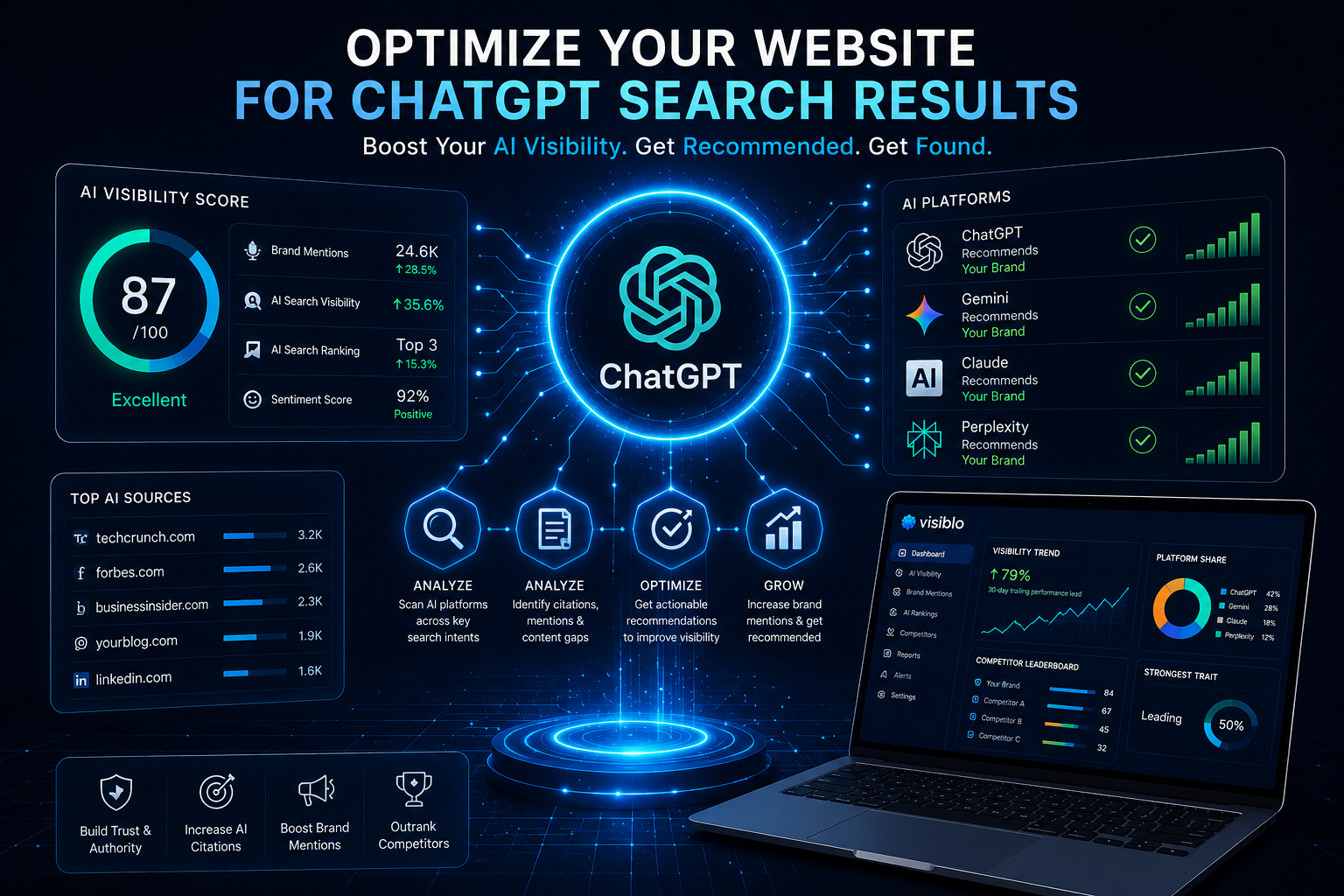
How to Optimize Your Website for ChatGPT Search Results
The world of search is evolving at an unprecedented pace. Rather than sifting through pages of results from Google, people today turn to AI-powered assistants such as ChatGPT to help them choose what to do, compare products, learn about software solutions, and run their businesses better.
When your company fails to come up with results from an AI-powered assistant such as ChatGPT, you miss out on great opportunities that would otherwise precede any search engine engagement.
In this guide, you will discover how to prepare your website for success in ChatGPT-powered search results.
Why ChatGPT Search Matters
Millions of users now rely on AI assistants to answer questions such as:
What is the best CRM for startups?
Which accounting software should I use?
Best project management tools?
Top marketing agencies near me?
Best AI SEO tools?
ChatGPT does not display ten blue links; instead, it creates an answer using credible sources from across the Internet.
Your business may fail to get mentioned in such AI-generated recommendations simply because your website isn’t included in the pool of information sources.
This is the reason why AI Search Optimization is now getting attention along with SEO.
What Does ChatGPT Look For?
Unlike traditional search engines, ChatGPT doesn't simply rank websites based on backlinks or keyword density.
It evaluates signals such as:
Brand authority
High-quality content
Trusted citations
Semantic relevance
Structured information
Entity relationships
Consistent brand messaging
Helpful and accurate content
The stronger these signals are, the better your chances of appearing in AI-generated responses.
1. Create Helpful, Intent-Focused Content
One of the biggest ranking factors for AI systems is content quality.
Instead of writing pages filled with keywords, focus on solving real user problems.
Your content should answer questions clearly and provide complete explanations.
For example, instead of creating a page titled:
"Best CRM Software"
Create content like:
Best CRM Software for Small Businesses
CRM Comparison Guide
How to Choose the Right CRM
CRM Pricing Explained
The more useful your content is, the easier it becomes for AI systems to reference it.
2. Build Strong Topical Authority
Publishing one article isn't enough.
ChatGPT prefers brands that consistently demonstrate expertise within a specific niche.
For example, if your business focuses on AI visibility, your content should cover topics such as:
AI Search Optimization
ChatGPT SEO
Generative Engine Optimization (GEO)
AI Brand Visibility
AI Search Rankings
AI Citations
AI Reputation Management
Creating interconnected content helps establish your website as an authoritative source.
3. Optimize for Entities Instead of Keywords
Modern AI understands entities rather than isolated keywords.
An entity can be:
Your business
Products
Services
People
Industries
Technologies
Ensure your website consistently explains:
Who you are
What you do
Who you serve
Why you're different
Which problems you solve
Clear entity signals help AI understand your brand more accurately.
4. Earn High-Quality Citations
ChatGPT frequently relies on information published across trusted websites.
That means your brand should appear in:
Industry blogs
Business directories
News websites
Research publications
Review platforms
Partner websites
These citations improve your credibility and increase the likelihood of AI mentioning your business.
5. Use Structured Data
Schema markup helps AI understand your website.
Consider implementing:
Organization Schema
FAQ Schema
Article Schema
Product Schema
Review Schema
Breadcrumb Schema
Structured data provides additional context that improves machine understanding.
6. Publish Original Research
AI models value unique information.
Publishing original content such as:
Industry reports
Case studies
Customer success stories
Survey findings
Benchmark reports
Statistics
can significantly improve your authority.
Unique data is more likely to be referenced than generic content.
7. Improve Internal Linking
Every important page should connect naturally with related content.
For example:
Blog → Service Page
Service Page → Case Study
Case Study → Pricing
FAQ → Blog Articles
A strong internal linking structure helps AI understand relationships between topics.
8. Maintain Consistent Brand Information
Your business information should remain consistent across:
Website
Social profiles
Business directories
Review platforms
Press mentions
Consistency strengthens your brand identity and reduces confusion for AI systems.
9. Keep Your Content Fresh
AI platforms prefer accurate and up-to-date information.
Regularly update:
Statistics
Product information
Service pages
Blog posts
Industry trends
Pricing information
Fresh content improves both user trust and AI confidence.
10. Measure Your AI Visibility
Traditional SEO tools cannot fully show how AI platforms perceive your brand.
Businesses should monitor:
AI Visibility Score
Brand mentions across ChatGPT
Citation opportunities
Competitor visibility
AI perception
AI source intelligence
Tracking these metrics helps identify where your brand is strong and where improvements are needed.
Common Mistakes to Avoid
Many businesses still optimize only for Google while ignoring AI search.
Avoid these mistakes:
Publishing thin content
Keyword stuffing
Ignoring structured data
Weak internal linking
Duplicate pages
Outdated information
No authority-building strategy
AI systems reward expertise and usefulness—not just keyword repetition.
The Future of Website Optimization
Searching behavior is changing fast. With people relying increasingly on ChatGPT and other AI-powered assistants to help them make decisions, companies must respond to these changes through their online presence.
It is going to be about providing quality content, developing authority, earning trustworthy citations, and optimizing for AI visibility. Those who implement Generative Engine Optimization now will have a head start in showing up in AI responses in the future.
Not a substitute for traditional SEO, AI optimization is just an enhancement of SEO and an effective means of making your brand visible online.
Conclusion
Optimizing your website for ChatGPT search engine results is becoming imperative for all businesses that aim to survive in the age of artificial intelligence.
With emphasis on quality content, semantics, structured data, topical expertise, and credible references, you will be able to enhance how AI will perceive and recommend your brand.
In case you wish to maximize your visibility across ChatGPT, Gemini, Claude, and Perplexity, it may be beneficial for you to utilize the help of an AI Visibility Optimizer.
The future of search belongs to brands that optimize not only for search engines but also for AI.
Frequently Asked Questions (FAQs)
1. What is ChatGPT Search Optimization?
ChatGPT Search Optimization is the process of improving your website so AI assistants can better understand, reference, and recommend your brand in AI-generated responses.
2. Is ChatGPT SEO different from traditional SEO?
Yes. Traditional SEO focuses on search engine rankings, while ChatGPT SEO emphasizes semantic relevance, authority, citations, and AI understanding.
3. What is Generative Engine Optimization (GEO)?
Generative Engine Optimization (GEO) is the practice of optimizing content and websites to improve visibility across AI-powered search platforms like ChatGPT, Gemini, Claude, and Perplexity.
4. Why are AI citations important?
The AI models use citations that are reliable and credible in developing the answer. Good citations make your brand more credible and increase the likelihood of recommendations.
5. How can I measure my AI visibility?
There are platforms that you can use to measure the AI visibility through brand mentions, AI citations, competitive analysis, visibility score, and optimizations for different AI models.